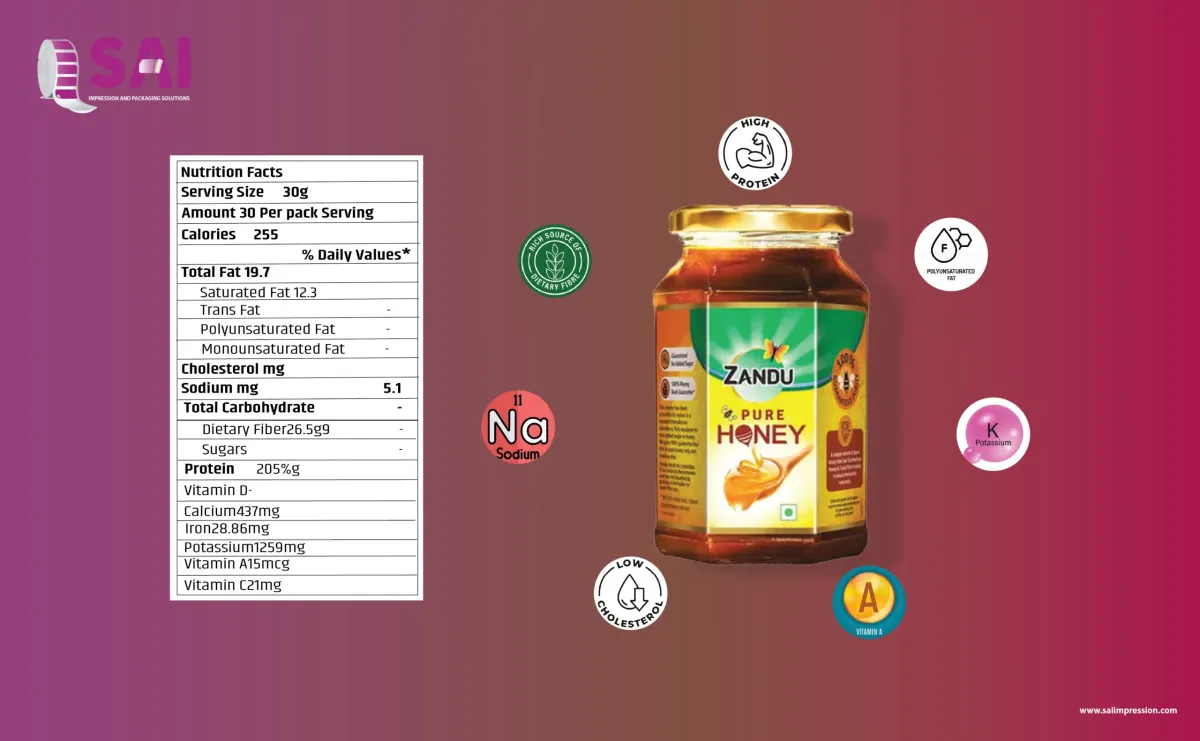
To get an FDA Nutrition Facts label, you work out your product's nutrient values per serving by lab analysis or a recipe database, set them out in the format FDA prescribes, and print the panel on your pack. There is no approval step: FDA does not pre-approve labels for food products, so the brand owner is responsible for getting it right. Nutrition labels are a regulatory requirement for most packaged foods, and they give buyers significant information. As a food business owner, having appropriate nutritional labels for your products always ensures transparency, and instills customer trust on what they buy and consume, ultimately helping them make informed choices. In this blog, let’s dive deep into what nutritional labels are, why nutritional labels are important, and how to get a nutritional label for your product.
What Information does a Nutritional Label Carry?
Here’s what a US food label needs to cover. The first six items belong in the Nutrition Facts panel, declared per serving and, for most nutrients, as a percent Daily Value (%DV). Ingredients and allergens are declared separately on the same label.
| Serving size |
| Calories per serving |
| Total fat, saturated fat and trans fat, plus cholesterol |
| Total sugars and added sugars |
| Sodium and total carbohydrate |
| Dietary fiber, protein, vitamin D, calcium, iron and potassium |
| Ingredients |
| Allergens |
However, based on the food packaging labels printed by each manufacturer, there is other nutrient information, mention of preservatives, regulated certifications, or even health warnings present on the nutritional label.
Under FDA's updated Nutrition Facts label rules, added sugars, vitamin D and potassium are mandatory and vitamins A and C are now optional. Manufacturers with USD 10 million or more in annual sales had to comply by 1 January 2020, and smaller manufacturers by 1 January 2021. Your allergen statement must cover the nine major US food allergens: milk, eggs, fish, crustacean shellfish, tree nuts, peanuts, wheat, soybeans and sesame, which became the ninth with effect from 1 January 2023.
Why is Nutritional Labeling Crucial?
Consumers are often at crossroads when it comes to grocery shopping. There is a new product coming up every single day. Food brands are springing like never before, and a nutritional label is something that can make you distinct from the rest.
Having an accurate nutritional label also heightens consumer trust, assuring accuracy of the product. Since these labels contain important information and are transparent about what goes into a particular food product, it helps consumers track their calorie intake, avoid certain allergens, or even choose based on taste preferences.
Hence, printing nutritional labels is highly integral when it comes to product packaging not only to boost brand value and trust but also enable consumers to make buying decisions that ensure healthy living.
Need labels like these for your products?
Tell us your product, quantity and market. Our team replies with a clear quote within 24 hours, for orders in India and for export.
Steps to Print a Nutritional Label for Your Food Product
Compliance is highly integral when it comes to creating a nutritional fact label. It is commonly printed based on applicable regulations of the country you manufacture and sell your product in. However, there are certain crucial factors that you need to keep in mind before you go ahead and package your brand’s consumables.
Step 1: Get the Nutritional Facts Right
Before designing a nutritional label, it is first essential to analyze the contents of the food product and understand what it contains. Lab testing is one of the most popular ways nutritional facts can be determined. These labs use the latest in food science to offer the list of ingredients and their respective percentage content in one serving of any food. While lab testing is highly accurate, as a food brand, you can also look up nutritional databases, or do a basic nutrient analysis based on your recipe. Whichever method you use, the declared values must hold up to laboratory analysis: under 21 CFR 101.9(g), naturally occurring nutrients such as protein, total carbohydrate and fiber must test at no less than 80% of the declared value, and calories, sugars, total fat, saturated fat, cholesterol and sodium may not exceed the declared value by more than 20%. Once the values for your serving size are ready, draft the label for a compliance check.
Step 2: Check Compliance Yourself (FDA Does Not Pre-Approve Labels)
For the US, there is no label approval to apply for: FDA does not pre-approve food labels, so the manufacturer, importer or brand owner carries the responsibility for a compliant label. Use FDA's Food Labeling Guide and the Nutrition Facts rules as your checklist, and ask your US importer or a regulatory consultant to review the draft. Once nutrient values are determined and the draft is ready, check it against the rules of every market where the product will be sold. For the US, the facility that manufactures, processes, packs or holds the food, including a foreign facility, must also be registered with FDA and renew every two years between 1 October and 31 December; FDA treats any registration not renewed by 31 December 2026 as expired. Each regulatory institution has a defined set of rules, food safety instructions, nutrients, and more which the product should be in line with.
Step 3: Format the Label
Formatting a nutritional label is the first step you have to make sure before heading to printing. Legible fonts, appropriate spacing, texts, and symbols should be used wherever necessary in accordance with the relevant regulatory body’s rules and compliance. Readability of the contents and its respective quantity/percentage should be ensured in a well organized manner. Furthermore, space out the ingredients properly so that consumers can quickly scan the label and make buying decisions.
For the US market the format is set by regulation, not by the designer: the panel must follow the layout, headings and type sizes in 21 CFR 101.9(d), with the nutrient declarations generally in type no smaller than 8 point. Ask your printer for a proof at actual size to check legibility before the full run.
Step 4: Design & Print the Nutritional Label
Now comes the deciding stage: designing and printing the label. Once the label content has been checked against the regulations of each market, it’s time to create a nutritional label with a reputed label provider for food packaging. Here are the steps you as a food brand need to follow.
- Lay out the nutritional label requirements
Ensure all the required information, nutrient breakdown, certification, health claims, and allergens are listed. Branding elements like logo, color palette, and fonts should be incorporated. Make a complete checklist before looking out for a good label printing company.
- Choose a trusted label provider
Partner with a reputed nutritional label provider with a wide range of customization options who will print your labels to accuracy, on high-grade printing stock, and in great quality. Discuss your requirements, and regulatory compliance with your label manufacturer for the best output.
- Mention the placement & design a label draft
The key purpose of a nutritional label should be fulfilled, and the placement of the label should be in such a way that it is easily visible and accessible to consumers. Finalize the design draft to get the best draft that aligns with your brand’s identity, aim, and reputation.
- Determine the order quantity
Gauge your product production in advance and estimate the required units of nutritional labels to be printed. Production needs differ by season, and hence, it is best advised to stock up additional quantities for future needs.
- Get the nutritional labels printed
Print your nutritional labels with great precision using the most appropriate printing technology. Your label provider like Sai Impression will majorly apply flexographic printing for large label quantities, and digital printing techniques for shorter, minimal quantities. Also, based on the product packaging and base material being bottles, jars, boxes, etc, different nutritional label styles like self-adhesive labels or pressure-sensitive labels are printed.
How to Find the Perfect Nutritional Label Provider for Your Products?
The most crucial step in getting the right nutritional label for your product is to find the best label provider in the industry. Look for a label supplier who houses a wide range of unique customization options, abides by regulatory standards, uses high-quality stock and new-age label printing techniques. This will make your label manufacturing and product packaging a breeze.
Keep in mind if the label manufacturer
- Has solid understanding of food labeling laws
- Focuses on durability
- Adopts industry-reliant printing practices
- Offers cost-effective labeling solutions
- Ensures a faster turnaround time
Wrapping Up,
Food products are plentiful in the market. While the quality and taste you provide decides the product’s success, consumer attention first starts with great packaging. And, no food labeling is complete without a legit nutritional label. Buyers are highly conscious about what goes into their body, and a nutritional fact label easily conveys the product’s composition, including serving sizes, calorie counts, allergens, and other crucial information. Hence, a legit, well-printed nutritional label is more than a necessity; it is a vitality for customer trust, and product credibility. Get your brand’s nutritional label from a reputed labeling supplier which serves both as a regulatory requirement, and a marketing tool that promotes your brand and enhances product success in the market.
Frequently asked questions
Does the FDA approve Nutrition Facts labels?
No. FDA does not pre-approve food labels. The manufacturer or brand owner must make sure the label meets FDA rules before the product is sold in the US.
Can a small business skip the Nutrition Facts label?
Sometimes. FDA's low-volume exemption covers firms with fewer than an average of 100 full-time equivalent employees selling fewer than 100,000 units of a product in the US in 12 months, but a notice must be filed with FDA every year, and products that carry nutrition claims do not qualify.
Is the FDA front-of-package Nutrition Info box mandatory?
Not yet. FDA's front-of-package nutrition labeling page still describes it as a proposed rule, with the comment period extended to 15 July 2025 and no compliance date given. Leave space on the front panel so a box can be added if the rule is finalised.