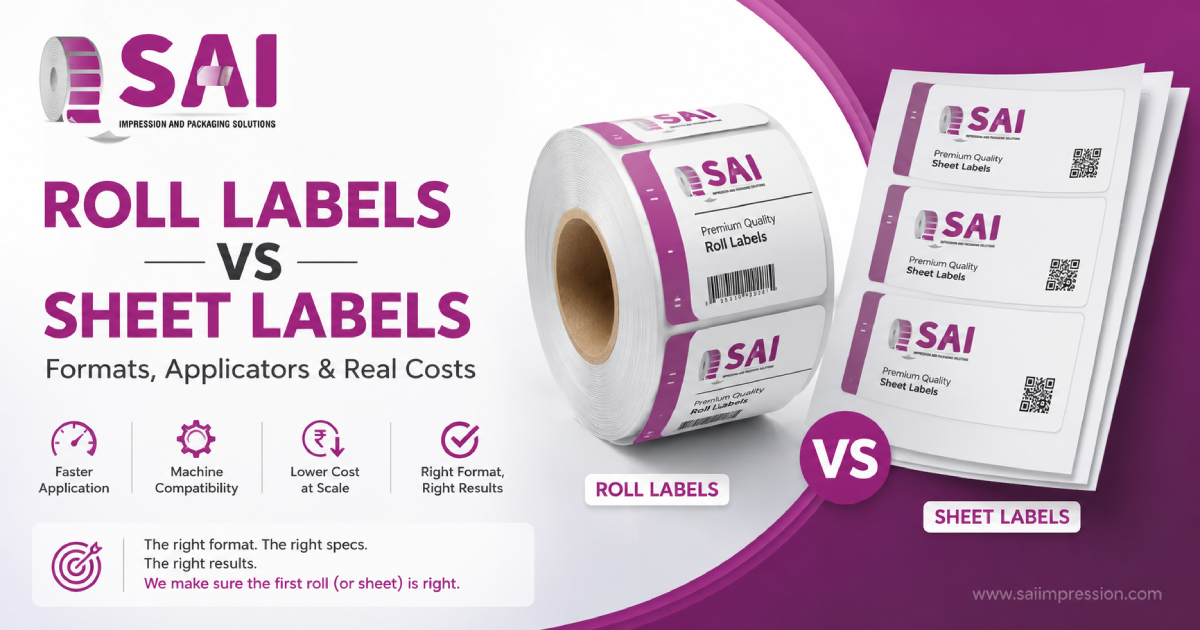
Every label order ends with a deceptively simple question: supplied on rolls or on sheets? The answer determines what equipment can apply them, how fast your line runs, and part of your unit cost. Choose based on how labels will actually be applied — not on habit.
The Two Formats in One Minute
Roll labels come wound on cores, die-cut and waste-stripped, ready for dispensers and automatic applicators. Sheet labels come flat (usually A4/A3 or custom), suited to office laser printers and low-volume hand application.
When Roll Labels Win
- Any automated or semi-automated application — applicators only accept rolls.
- Volume hand-labelling — a bench-top dispenser doubles operator speed vs peeling from sheets.
- Thermal and inkjet on-demand printing — barcode and batch printers are roll-fed; see thermal printer labels.
- Lower cost at volume — roll converting is the native output of label presses; sheets add a step.
- Cleaner storage — rolls resist dust, curl and edge damage better than opened sheet packs.
When Sheet Labels Win
- Office laser/inkjet printing of address, file or event labels.
- Very small runs of many designs — a sheet can carry mixed designs.
- Craft and sampling stages — before committing to converted rolls.
Decision Table
| Your Situation | Format |
|---|---|
| Automatic labelling line | Rolls (mandatory) |
| Hand application > 200/day | Rolls + dispenser |
| Thermal barcode printing | Rolls |
| Office printing, tiny volumes | Sheets |
| Retail product labelling at scale | Rolls |
Roll Specs Buyers Get Wrong (Worth 10 Minutes)
- Core size: 25 mm (1"), 40 mm (1.5") and 76 mm (3") are common — your printer/applicator dictates it.
- Max roll diameter: desktop printers cap around 110–127 mm; industrial take 200 mm+. Bigger rolls = fewer changeovers, if they fit.
- Wind direction: labels can unwind face-out or face-in, leading with top, bottom, left or right edge — applicators need a specific orientation (commonly specified as Wind #1–#8). Wrong wind = unusable rolls.
- Labels per roll & gaps: affects line stops; applicator sensors also need the right label gap (typically 3 mm).
- Perforations between labels — helpful for hand-tearing, harmful on high-speed applicators.
Ordering rolls for a new printer or applicator? Tell Sai Impression the machine model — we convert to the exact core, diameter, wind and gap it needs, first roll right. Spec my rolls →
Cost Reality
For product labelling at any real volume, rolls cost less per label and far less per applied label once labour is counted. Sheets earn their keep only where their flexibility is actually used. Wider cost levers in our label cost guide.
FAQ
Can I use roll labels without any machine?
Yes — peel and apply by hand, or add an inexpensive bench dispenser that presents each label ready to lift. Above a couple of hundred labels a day, the dispenser pays for itself quickly.
What core size do I need for my label printer?
Desktop thermal printers usually take 25 mm (1") cores with rolls up to ~110–127 mm diameter; industrial printers take 76 mm (3") cores with much larger rolls. Check the printer manual — then order to it.
What does wind direction mean on label rolls?
It specifies which edge of the label comes off the roll first and whether labels face in or out — standardised as positions #1–#8. Applicators and printers each require a specific wind; always confirm before converting.
Are sheet labels cheaper than roll labels?
Only at very small office-print quantities. For converted product labels, rolls are the native, cheaper format — and dramatically cheaper per applied label once application speed is counted.