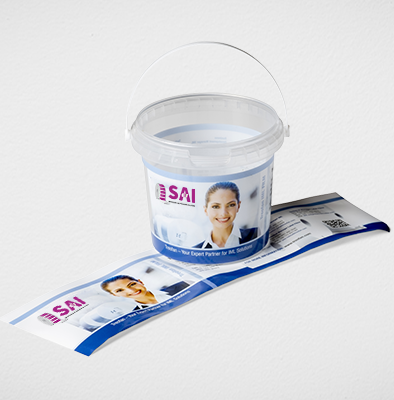
In-mould labelling (IML) takes a different route from every other label format: a pre-printed polypropylene label is placed inside the mould, and the container is formed around it. Label and pack fuse into one piece - the label can never peel, bubble or fall off, because it is not stuck on; it is part of the wall.
Once a format reserved for premium ice-cream tubs, IML is now mainstream across food containers, paint pails and caps. These are the benefits that make the economics work. (Format basics on our in-mould labels page.)
1. Permanent By Construction
No adhesive means no adhesive failures. Freezers, dishwashers, oily contents, humid warehouses - none of the classic label-killers apply. For products that live in tough environments, IML eliminates an entire defect category, including everything in our cold-storage failure guide.
2. Premium No-Label Look, All the Way Around
The label sits flush with the container wall - no raised edges, no visible label boundary. Full-wrap photographic-quality graphics give injection-moulded tubs the shelf presence of premium rigid packaging.
3. Hygiene and Food Safety
The fused construction leaves no adhesive layer or label edge where moisture and microbes can collect - a genuine benefit for dairy, edible fats and food-service containers, and easy to validate in audits.
4. One Process Step Instead of Two
Labelling happens inside the moulding cycle. There is no downstream labelling line to buy, staff, maintain or slow down - decoration is complete the moment the container leaves the mould.
5. Mono-Material Recyclability
A PP label fused to a PP container is a single-polymer pack - exactly what recyclers want, and a headline item in our 2026 sustainable materials trends.
6. Durability Against Abrasion
Print is protected under the surface rather than sitting on top of it. Stacked pails, transit rub and retail handling do not scuff the artwork - critical for paint, lubricants and construction products.
7. Design Freedom on Complex Shapes
Because the label forms with the container, it decorates tapered tubs, rounded corners and recessed panels that pressure-sensitive labels wrinkle on and sleeves cannot grip.
8. Total-Cost Economics at Volume
Per-label cost is higher than a paper sticker - but add application machinery, labour, rejects and re-labelling, and IML frequently wins on total cost for high-volume moulded packs. It pairs naturally with long-run flexo economics discussed in digital vs flexo.
Moulding containers in PP? Sai Impression supplies IML labels ready for robotic placement, matched to your mould dimensions and cavitation. Discuss your container spec →
Where IML Fits Best
| Application | Why IML Wins |
|---|---|
| Ice cream & dairy tubs | Freezer-proof, hygienic, premium look |
| Paint & construction pails | Abrasion-proof, no peeling in stacking |
| Food-service containers | Dishwasher-safe, food-contact friendly |
| Caps & closures | Decorates during moulding, no extra step |
| Reusable packaging | Survives hundreds of use cycles |
FAQ
What is the difference between IML and shrink sleeves?
A sleeve is applied and shrunk onto a finished container; an IML label fuses into the container wall during moulding. IML suits injection-moulded tubs and pails; sleeves suit bottles and complex curved packs - comparison in our IML vs shrink sleeve guide.
Can IML labels go in the freezer and microwave?
Yes - the fused PP construction survives deep freeze and, with suitable container grades, microwave reheating. This is why ice-cream and ready-meal tubs adopted IML first.
Is IML more expensive than sticker labels?
Per label, usually yes. Per decorated container at volume - including application labour, machinery and rejects - IML is often cheaper. Run the total-cost numbers, not the label price alone.
Do I need special moulding equipment for IML?
You need label-placement automation (typically robotic) integrated with the moulding machine. Many moulders in India already run IML cells - we supply labels matched to their handling specs.