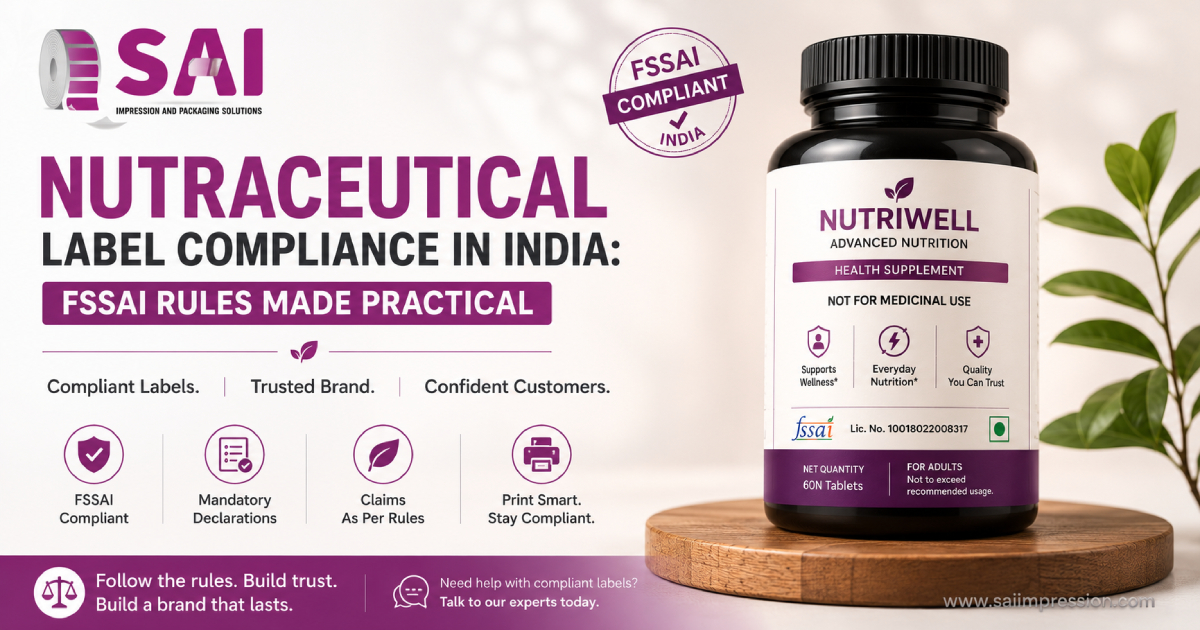
India’s nutraceutical market is booming — and so is regulatory attention on its labels. FSSAI’s framework for health supplements and nutraceuticals sets out exactly what your label must declare, how claims may be worded, and what gets products pulled from shelves. Here is the practical version for brand owners preparing artwork.
This guide is an orientation, not legal advice — always validate final artwork against the current regulations and your product’s specific approval.
Which Rules Apply to You?
Health supplements, nutraceuticals, foods for special dietary use and similar categories fall under FSSAI’s nutraceutical regulations, layered on top of the general food labelling rules. Practical consequence: your label must satisfy both the general food labelling requirements and the category-specific ones below.
The Mandatory Declarations Checklist
- Product name + category statement — e.g. “Health Supplement”, stated clearly.
- “NOT FOR MEDICINAL USE” — the statement regulators look for first.
- Complete ingredient list with quantities of nutrients/actives per serving, and % RDA where applicable.
- Recommended usage/serving and the advisory not to exceed it.
- Target consumer & warnings — “not for children below…”, pregnancy/lactation cautions where relevant.
- FSSAI license number and logo — of the brand owner and manufacturing unit as applicable.
- Veg/non-veg mark at prescribed size and placement.
- Batch/lot, MFG and EXP/best-before dates — printed legibly, not dot-matrix smudge.
- Net quantity, MRP, customer-care details per Legal Metrology rules.
- Storage instructions matched to the product’s stability data.
Claims: Where Brands Get Into Trouble
- Permitted: nutrient-content and approved health/function claims consistent with the schedules and your formulation evidence.
- Prohibited: disease treatment/cure/prevention claims — “cures diabetes”, “fights cancer” and softer versions of the same idea.
- The grey zone: implied claims via imagery and testimonials count as claims. Regulators read pictures too.
Format & Legibility Requirements
Minimum font sizes scale with pack size; declarations must contrast with the background; the veg mark has fixed size rules. Cramming is the enemy — our label sizing guide shows how to establish the area your mandatory text actually needs before design begins.
Print Decisions That Protect Compliance
- Print batch/expiry into the label via variable data printing instead of line overprinting — crisp, verified, never misaligned or missing.
- Serialized QR verification defends against the counterfeit supplements plaguing the category — exactly what we built in this nutraceutical case study.
- Durable materials: bathroom-cabinet humidity and oil contact demand film faces or laminated stocks — see the nutraceutical labels page for constructions we recommend.
- Tamper evidence: induction seals plus tamper-evident labels reassure both regulators and customers.
Preparing a supplement launch? Send Sai Impression your draft artwork — we flag layout-level compliance gaps (sizes, marks, placements) and print with batch-coded variable data. Get a compliance-aware quote →
FAQ
Is “NOT FOR MEDICINAL USE” mandatory on supplements in India?
Yes — health supplements and nutraceuticals must carry this statement prominently. Its absence is one of the fastest routes to enforcement action.
Can supplement labels claim to cure or treat diseases?
No. Disease treatment, cure or prevention claims are prohibited for this category — including implied versions through images or testimonials. Only permitted nutrient and function claims consistent with the schedules may be used.
Do imported supplements need Indian labels?
Yes — imported products must meet FSSAI labelling requirements, commonly via compliant stickers or repacked labels applied before sale, carrying the importer’s FSSAI details among other declarations.
What font size is required for supplement label text?
Minimum sizes scale with the package’s surface area under the labelling regulations. Design to the prescribed table for your pack size and keep high contrast — then confirm the final artwork against current rules.