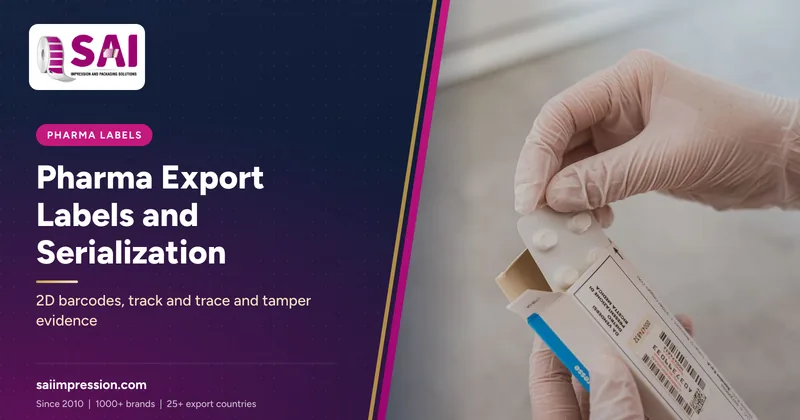
Indian pharmaceutical exporters supply medicines to more than a hundred countries, and almost every major market now expects packs to carry machine-readable product identification. Serialisation, 2D barcodes and tamper evidence have become standard requirements in pharmaceutical exports. A pack that cannot be scanned and verified at its destination may not be accepted into the supply chain.
This guide gives export, regulatory and packaging teams an overview of the serialisation and labelling requirements in key markets, the role labels play and what to ask your label supplier. It is a practical overview, not legal advice. Always confirm requirements with your regulatory team before finalising artwork.
Short answer: most regulated markets now require each saleable pharmaceutical pack to carry a unique identifier, usually a GS1 DataMatrix barcode containing the product code, serial number, batch and expiry, with the same data in human-readable form. Many also require tamper-evident features. India requires GS1 barcodes on export packaging, the US enforces DSCSA and the EU enforces the Falsified Medicines Directive.
Key takeaways
- A 2D DataMatrix with GTIN, serial number, batch and expiry is the common building block across markets.
- Barcode print quality is graded. Buyers and regulators expect codes that scan reliably everywhere.
- Tamper-evident labels and seals are required or expected in several markets.
- Labels must leave clear, uncoated space where your line prints variable data.
Market requirements at a glance
| Market | Key requirement | What it means on the pack |
|---|---|---|
| India (exports) | DGFT track and trace rules for pharmaceutical exports | GS1 barcodes on secondary and tertiary packaging, with primary level requirements deferred. Check the current DGFT notification. |
| India (domestic) | QR codes on specified drug brands under Schedule H2 | A QR code with product details on the primary or secondary pack of listed brands since August 2023 |
| United States | Drug Supply Chain Security Act (DSCSA) | Product identifier with NDC, serial number, lot and expiry in a 2D DataMatrix and human-readable form on packages and homogeneous cases |
| European Union | Falsified Medicines Directive and Delegated Regulation (EU) 2016/161 | Unique identifier in a 2D DataMatrix plus an anti-tampering device on prescription medicines since February 2019 |
| Gulf states | National track and trace systems, such as Saudi Arabia's and the UAE's | GS1 DataMatrix serialisation and reporting to national systems |
Requirements and deadlines change, and many markets introduced phased timelines or exemptions for certain trading partners. Use this table as a starting point and confirm each market with your regulatory affairs team.
What goes into a serialised pharmaceutical code
- Product code: a GTIN, or a national code embedded in a GTIN such as the US NDC.
- Serial number: unique to each saleable pack, usually randomised.
- Batch or lot number: linking the pack to the production record.
- Expiry date: in the format required by the market.
- Additional national data: some markets require a reimbursement or registration number.
These elements are encoded in a GS1 DataMatrix using application identifiers and repeated in human-readable text next to the code. For background on GS1 identifiers, see our guide to barcode label printing and GS1 standards.
Where labels fit into serialisation
In most pharmaceutical plants, unique serial numbers are printed on the packaging line by inkjet, laser or thermal transfer coders and checked by vision systems. The label supplier's job is to supply labels and cartons that make that process reliable:
- A clear coding window: an area without varnish, foil or heavy ink where the coder prints sharply.
- The right facestock: a surface matched to your coding technology, whether thermal transfer, inkjet or laser.
- Consistent registration: the coding window must be in the same place on every label so cameras find it.
- Pre-printed fixed data: product name, strength, legal text and static barcodes printed to a high standard.
For some programmes, especially smaller volumes, labels can arrive pre-serialised. Using variable data printing, unique codes from your data file are printed during label production and verified before dispatch, so your line only needs to apply them.
Preparing pharmaceutical labels for export?
Share your pack formats, coding method and target markets. We will supply labels with clean coding windows, tamper-evident options and consistent registration, with a quote within 24 hours.
Barcode quality: grading matters
2D barcodes are graded for print quality under ISO/IEC 15415. Buyers commonly specify a minimum grade, and grade C (1.5) or better is a widely used target in healthcare. Poor contrast, smudged modules or a code printed over a textured surface can drop the grade below the threshold even when a phone camera still reads it. Ask your label supplier to verify printed codes with a calibrated verifier rather than a simple scanner.
Tamper evidence
The EU requires an anti-tampering device on prescription medicines, and tamper evidence is expected by buyers in many other markets. Common label-based solutions include:
- VOID labels and seals that leave a visible pattern if peeled.
- Destructible films that break into small pieces when removed.
- Carton closure seals placed across the opening flap.
- Security features such as micro text, holographic elements and unique QR codes for authentication.
See how we produced tamper-evident VOID security labels for a pharmaceutical brand, and read our overview of anti-counterfeit label technologies.
Aggregation: linking packs, cases and pallets
Many markets and buyers expect aggregation, which records which serialised packs are in which case and which cases are on which pallet. Cases and pallets are identified by their own codes, usually an SSCC, so a single scan can reveal the contents. Our guide to carton and pallet labels for export shipments explains SSCC labels in detail.
How Sai Impression supports pharmaceutical exporters
Sai Impression prints medical and pharmaceutical labels in Chennai with fine legal text, consistent registration, clean coding windows, tamper-evident films and variable data printing for unique codes. Since 2010 we have worked with more than 1000 brands and supplied labels to over 25 countries. For wider industry context, see our articles on FDA compliance in pharma labelling and pharmaceutical labelling and packaging trends.
Frequently asked questions
What is pharmaceutical serialisation?
Serialisation means giving each saleable pack a unique identifier, usually a serial number combined with the product code, batch and expiry in a 2D DataMatrix barcode. It lets the pack be traced and verified through the supply chain.
Is a QR code acceptable instead of a DataMatrix?
For regulated serialisation in the US and EU, the GS1 DataMatrix is the expected symbol. India's Schedule H2 requirement uses QR codes for listed brands sold domestically. Follow the symbol each market specifies.
Who prints the serial numbers, the label supplier or the factory?
Usually the factory, on the packaging line, because serial numbers must be linked to the batch in real time. Pre-serialised labels from the supplier are an option for some programmes and smaller volumes.
What barcode grade do buyers expect?
Many buyers specify grade C (1.5) or better under ISO/IEC 15415 for 2D codes. Check your buyer's quality agreement, as some require a higher grade.
Which label features help meet tamper-evidence requirements?
VOID labels, destructible films and carton closure seals are common choices. They show clear evidence if the pack has been opened. Your regulatory team should confirm the solution meets the market's requirements.
Ready your pharma packs for every export market
Tell us your products, pack formats and target markets. We will recommend label builds and security features and send you a quote.
Sources and further reading: US FDA: DSCSA, European Commission: falsified medicines, DGFT India, GS1 Healthcare. Requirements and timelines change, so confirm details with your regulatory team.