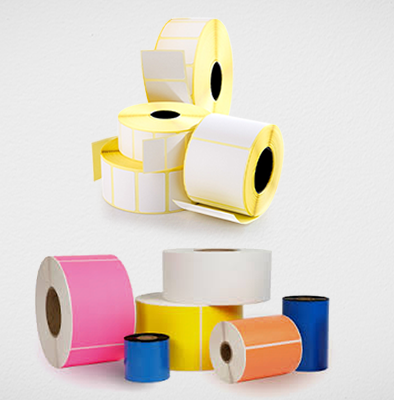
If you print barcode or product labels on a thermal transfer printer, the ribbon decides print durability just as much as the label stock does. Pair them wrong and you get smudged batch codes, unreadable barcodes after transit, or money wasted on durability you never needed.
First: Direct Thermal vs Thermal Transfer
Direct thermal printing needs no ribbon - heat darkens a coated label. Simple, but the print fades with time, heat and sunlight; right for short-life shipping labels. Thermal transfer melts ink from a ribbon onto the label - durable, crisp and long-lived; right for product, asset, compliance and cold-chain labels. Both run on stocks from our thermal printer labels range.
The Three Ribbon Families
1. Wax Ribbons (Economy)
Best on: paper labels. Strengths: lowest cost, prints at low energy (long printhead life). Limits: smudges under rubbing, fails with moisture or chemicals.
Use for: shipping cartons, shelf labels, dry-goods batch coding.
2. Wax-Resin Ribbons (Mid-Range)
Best on: coated papers and matte synthetic labels. Strengths: markedly better smudge and scratch resistance, moderate chemical tolerance.
Use for: product labels touched often, refrigerated goods, healthcare, retail returns handling.
3. Resin Ribbons (Maximum Durability)
Best on: synthetic labels (PP, PET, PE). Strengths: resists chemicals, solvents, abrasion, outdoor exposure and extreme temperatures; the choice for compliance-critical marks.
Use for: chemical drums (dangerous goods labelling), laboratory and cryogenic vials, automotive and electronics asset tags, marine/outdoor equipment.
Matching Table (Cut This Out)
| Label Stock | Ribbon | Typical Life |
|---|---|---|
| Uncoated paper | Wax | Months, dry indoor |
| Coated paper | Wax or wax-resin | 1-2 years indoor |
| PP / BOPP film | Wax-resin or resin | Years |
| PET film | Resin | Many years, harsh conditions |
| PE (squeezable) | Wax-resin / resin | Product life |
Buying Details People Miss
- Ink side: ribbons wind coated-side-in (CSI) or coated-side-out (CSO) - match your printer or nothing prints.
- Width: ribbon should be slightly wider than the label to protect the printhead edge.
- Printhead settings: resin needs higher energy; recalibrate darkness/speed per ribbon change or you will blame the wrong component.
- Verification: if barcodes must meet retailer grades, verify after any ribbon/stock change - rules in our GS1 barcode guide.
Buying ribbons and labels together? Sai Impression supplies matched label-plus-ribbon combinations tested for your exact printer model - one order, guaranteed print quality. Get a matched quote →
FAQ
Which ribbon should I use for barcode labels?
On paper labels indoors, wax is fine. If labels face handling, moisture or chill, use wax-resin. For synthetics or chemical/outdoor exposure, resin. The barcode must survive to the point of scan - choose backwards from that.
Why does my thermal print smudge?
Usually a wax ribbon doing a wax-resin job, or printhead energy set too low for the ribbon. Match ribbon to stock and recalibrate darkness - smudging disappears.
Can I use resin ribbon on paper labels?
It bonds poorly - resin is engineered for synthetic surfaces and can flake off paper. Use wax or wax-resin on paper.
Is direct thermal cheaper than thermal transfer?
Per label, often yes (no ribbon). But the print fades in months and reacts to heat and light, so it only suits short-life applications like courier labels. Product and compliance labels should be thermal transfer.