You’re walking down a store aisle. Your hand brushes against a product that doesn’t feel like the others. It’s raised, textured, and intriguing. Instinctively, you pick it up.
That moment isn’t luck: it’s sensory packaging powered by tactile labels.
In today’s retail environment, where a typical US supermarket carries 33,248 items (FMI supermarket facts, 2025), relying only on visual packaging is no longer enough. Touch plays a powerful role in influencing buying decisions.
Tactile labels add a physical dimension to packaging, turning casual browsing into meaningful interaction.
In short: tactile labels stand out because texture contrasts with the smooth, flat labels around them and invites shoppers to pick the product up. Research on touch shows that handling a product raises the shopper's feeling of owning it, which can increase willingness to pay when the feel is pleasant.
Brands across the USA and India are increasingly adopting tactile label printing to create memorable packaging experiences that drive sales.
In this article, you’ll learn:
- What tactile labels are
- Why they influence customer buying decisions
- How tactile packaging improves brand perception
- Practical design tips to make tactile labels effective
What Are Tactile Labels? (Your Product’s First Handshake)
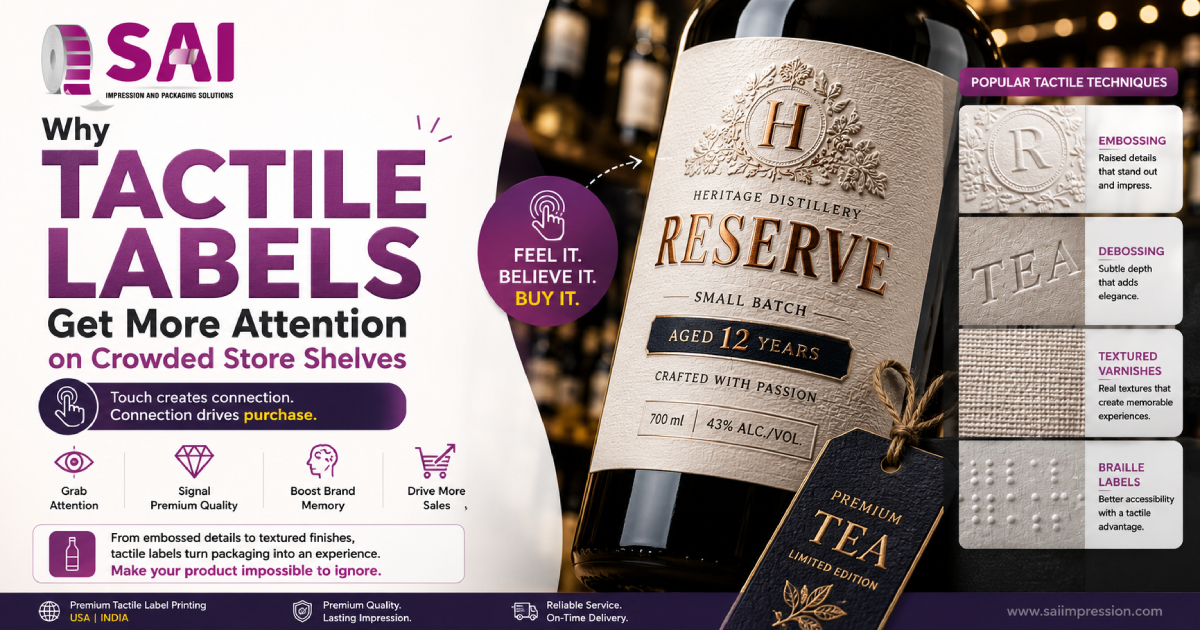
Tactile labels are packaging labels designed to be felt, not just seen. They incorporate raised, recessed, or textured finishes that encourage shoppers to physically interact with a product.
These labels transform packaging from visual communication into a sensory experience.
Common Tactile Label Techniques
- Embossing: Raised elements that highlight logos, symbols, or product names.
- Debossing: Pressed impressions that create subtle depth and sophistication.
- Textured Varnishes: Special coatings that mimic surfaces like linen, leather, sand, or stone.
- Braille Labels: Raised dots that improve accessibility while adding a tactile layer.
Where Tactile Labels Are Commonly Used
You’ll often see tactile labels on:
- Premium whiskey or wine bottles with embossed crests
- Luxury skincare containers with soft-touch finishes
- Artisan coffee packaging with rough textured coatings
- Premium tea or gift box packaging
Think of tactile labels as your product’s handshake with the customer: the first physical interaction that creates a lasting impression.
On self-adhesive labels, Sai Impression offers tactile and high-build UV finishes as well as hot and cold foil. See our specialty labels range for the options.
The Psychology of Touch in Packaging
Touch plays a powerful role in how consumers evaluate products. This concept is known as haptic perception, which studies how physical sensations influence emotions and decisions.
When shoppers interact with textured packaging, their brain processes the product as more premium, trustworthy, and carefully crafted.
Need labels like these for your products?
Tell us your product, quantity and market. Our team replies with a clear quote within 24 hours, for orders in India and for export.
Why Texture Influences Buying Decisions
A flat label often feels mass-produced.
A tactile label feels:
- Premium
- Authentic
- Carefully designed
- Higher in quality
Research Supporting Tactile Packaging
Research shows how touch affects the way people value products:
- A 2009 Journal of Consumer Research study by Joann Peck and Suzanne Shu found that merely touching an object increases the feeling of owning it. In their four studies, people were willing to pay more for objects they could touch, unless the touch felt unpleasant.
- The same research shows that the quality of the feel matters: an unpleasant texture lowers willingness to pay, so test any finish with real shoppers before a full run.
In practice, shoppers may not recall a brand name but may recall “the product with that unique textured label.”
Why Tactile Labels Win the Retail Shelf Battle
Retail shelves are dominated by glossy, visually similar packaging. Tactile labels break this pattern and create an instant advantage.
1. They Create Shelf Contrast
When most products feel smooth and flat, a textured label immediately stands out.
2. They Encourage Physical Interaction
Once a shopper touches a product, their sense of ownership rises, which can raise willingness to pay when the feel is pleasant. Touch builds subconscious familiarity.
3. They Signal Premium Quality
Texture communicates craftsmanship and attention to detail, helping justify higher pricing.
4. They Improve Brand Memory
Adding touch gives shoppers a second sensory cue to remember a product by, alongside the visuals.
How Brands Use Tactile Packaging
Craft Brewery Example
Consider a craft brewery that adds embossed mountain icons and sand-textured varnish to its beer labels.
Result:
The tactile finish makes the beers easier to spot, especially next to smooth, flat labels.
Premium Tea Brand Example
Consider a luxury tea brand that launches Diwali gift boxes with linen textures and gold debossing.
Result:
The finish gives the collection a gifting feel, which suits a higher price point.
These illustrative examples show how sensory packaging can support purchasing decisions.
Printing & Design Tips for Effective Tactile Labels
To maximize impact, tactile labels should be used strategically rather than excessively.
Starter Tips
- Highlight one key element such as the logo or product name
- Keep the tactile area focused and intentional
- Choose textures that align with brand identity
Professional Design Tips
- Combine techniques such as debossing with foil stamping
- Use thicker paper stock (high GSM) for deeper embossing effects
- Collaborate with packaging printers early in the design phase
Premium Packaging Tips
- Provide high-resolution vector artwork for precise embossing
- Apply protective laminates to preserve texture during shipping
- Test prototypes before full production
Tactile Labels vs Standard Labels
| Feature | Tactile Labels | Standard Labels |
|---|---|---|
| Visual Appeal | Premium and sensory | Functional and simple |
| Customer Engagement | Encourages touch and interaction | Relies on visuals |
| Brand Perception | High-quality and premium | Neutral |
| Durability | High with protective coatings | Moderate |
| Cost | Higher investment | Budget-friendly |
| Best Use | Luxury, gifting, premium brands | FMCG and high-volume products |
Why Brands Are Investing in Tactile Label Printing
Businesses today understand that packaging is more than protection: it’s a marketing tool.
Tactile labels help brands:
- Increase shelf visibility
- Create memorable brand experiences
- Improve perceived product value
- Encourage impulse purchases
For premium products, the return on investment from tactile packaging can outweigh the additional printing cost when the product supports a premium price.
Conclusion: Packaging That Gets Picked Up
In a crowded retail environment, the products that invite touch are the ones that get noticed first.
Tactile labels help brands:
✔ Grab attention on crowded shelves
✔ Communicate quality and craftsmanship
✔ Strengthen emotional connection with customers
✔ Increase purchase likelihood
At Sai Impression, we specialize in high-quality tactile label printing for brands across the USA and India, helping products stand out with premium packaging that customers remember.
FAQ
What are tactile labels?
Labels with raised (embossed), recessed (debossed), or textured elements designed to engage touch.
Why do they stand out more?
They create contrast in a sea of smooth labels, triggering curiosity and physical interaction.
Are tactile labels only for luxury products?
No. Even mid-range brands can use subtle textures to increase perceived value and stand out.
Do tactile labels really boost sales?
They can help, but results depend on the product, the shelf and how good the finish feels. Touch research links a pleasant feel to higher willingness to pay, so test a prototype before a full run.
Can tactile labels include barcodes or QR codes?
Absolutely. Keep the barcode or QR area flat and high-contrast so it scans reliably. See our guide to QR codes on packaging.