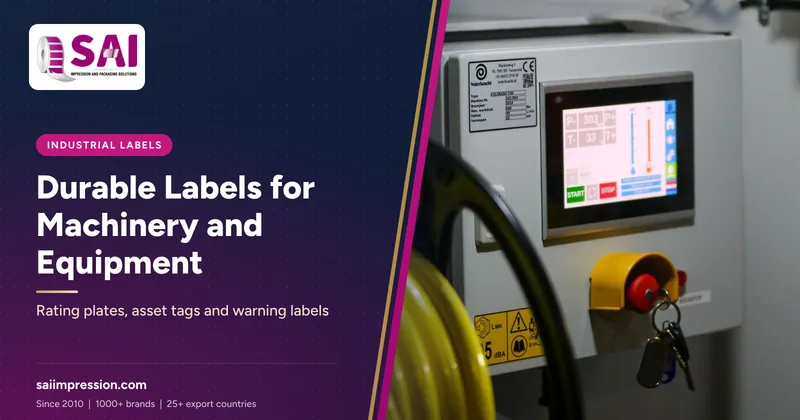
A rating plate on a motor, a warning label on a control panel or an asset tag on a generator has to stay readable for the working life of the equipment. That can mean ten years or more of heat, oil, cleaning chemicals, vibration and sunlight. When a label fails, the cost is not the label. It is a failed inspection, a rejected shipment or a service engineer who cannot identify the unit.
This guide is for OEMs, panel builders, pump and motor manufacturers, electrical equipment makers and their procurement teams. It explains which label materials last, what information equipment labels usually carry and how to specify durable labels for export markets.
Short answer: durable equipment labels are usually printed on polyester (PET), polycarbonate or metallised polyester, protected by an overlaminate, and fixed with a high-performance acrylic adhesive matched to the surface. Rating plates, safety labels and asset tags must stay legible and attached for the life of the product, so material, adhesive and print method should be chosen together and tested on your actual surface.
Key takeaways
- Paper labels have no place on machinery. Use synthetic films with an overlaminate or protective varnish.
- Powder-coated and plastic surfaces often need a special low surface energy adhesive.
- Variable details such as serial numbers and barcodes can be printed in the same run with variable data printing.
- If a certification scheme requires recognised label materials, raise it at the RFQ stage, not after printing.
Types of labels on machinery and electrical equipment
| Label type | Purpose | Typical content |
|---|---|---|
| Rating or name plate | Identifies the product and its technical ratings | Manufacturer, model, serial number, voltage, current, power, frequency, year, conformity marks |
| Safety and warning labels | Warns users of hazards | Hazard symbols, signal words, short instructions |
| Control panel overlays | Identifies switches, buttons and indicators | Icons, text, windows for displays |
| Asset and inventory tags | Tracks equipment through its life | Asset number, barcode or QR code, owner details |
| Wiring and component labels | Identifies cables, terminals and parts | Codes, numbers, short text |
| Service and calibration labels | Records maintenance status | Dates, initials, next service due |
What goes on a rating plate for export markets
Each market and product category has its own rules, so always confirm requirements with your compliance team or certification body. As a general guide:
- EU (CE marking): machinery placed on the EU market typically carries the manufacturer's name and address, the machine designation, series or type, serial number where applicable, year of construction and the CE mark. The EU Machinery Regulation (EU) 2023/1230 replaces the Machinery Directive from January 2027, so check which applies to your launch date.
- Great Britain (UKCA): similar information with the UKCA mark and a UK importer address where required. The UK has extended recognition of CE marking for many product categories, so confirm the current position.
- USA and Canada: electrical products listed by a certification body carry the listing mark and the ratings it specifies. Some certification programmes require label materials recognised under UL 969 in the US or CSA C22.2 No. 0.15 in Canada.
- Gulf states: many regulated products need conformity marking under national or GCC schemes. See our guide to UAE and GCC label requirements.
Safety labels often follow recognised formats such as ISO 3864-2 internationally and ANSI Z535.4 in the US. Using a consistent format across your range makes your manuals, labels and training easier to align.
Choosing durable materials
| Material | Strengths | Common uses |
|---|---|---|
| White or clear polyester (PET) | Heat, chemical and abrasion resistance, dimensional stability | Rating plates, warning labels, component labels |
| Metallised polyester (silver or brushed) | Metal look without the cost and weight of a metal plate | Name plates, premium branding on equipment |
| Polycarbonate | Rigid, printable on the reverse, good for windows and embossed keys | Control panel overlays, front fascias |
| Tamper-evident VOID film | Shows a pattern if someone tries to remove it | Warranty seals, asset tags, service seals |
| Vinyl and conformable films | Flexible, follows curves and rivets | Curved housings, cylindrical tanks |
For a broader comparison of facestocks, see our guide to paper vs film labels. For tamper-evident options, read anti-counterfeit label technologies.
Protecting the print
A clear polyester overlaminate protects the printed surface against solvents, oils, cleaning agents and abrasion. Matt overlaminates reduce glare on panels under workshop lighting. For outdoor equipment, ask for UV-stable inks and laminates so reds and yellows on warning labels do not fade.
Choosing the adhesive
Most label failures on equipment are adhesive failures. Powder-coated steel, textured plastics and polypropylene housings are low surface energy materials that standard adhesives do not grip well. A high-tack or low surface energy acrylic adhesive solves this in most cases. For hot surfaces such as motor housings, check the adhesive's service temperature range. Our label adhesive buying guide explains the options.
Need labels that last the life of your equipment?
Tell us the surface, operating temperature, chemicals and markets. We will recommend a material, laminate and adhesive build and quote within 24 hours.
Serial numbers, barcodes and QR codes
Rating plates and asset tags almost always include unique data. There are two practical ways to add it:
- Pre-printed by your label supplier: with variable data printing, each label in a roll carries its own serial number, barcode or QR code, printed in sequence from your data file. This suits volume production and reduces errors on the line.
- Printed in your factory: blank or partly printed labels are finished on a thermal transfer printer at the end of the line. Use a resin ribbon on polyester for the best durability. See our thermal transfer ribbon buying guide.
QR codes on equipment are increasingly used to link to manuals, spare parts and service records, which also helps you meet growing expectations for digital product information.
Testing before you approve
- Apply sample labels to production parts, not to a clean test sheet.
- Wait at least 24 hours for the adhesive to build full strength before testing.
- Rub the label with the oils, fuels or cleaning agents it will meet in service.
- Check adhesion after heat cycling if the equipment runs hot.
- Scan barcodes and QR codes after the chemical and abrasion tests.
For heavy chemical exposure, our case study on BS 5609 chemical-resistant drum labels shows how a demanding specification was met.
How Sai Impression supports equipment manufacturers
Sai Impression prints specialty labels and industrial labels in Chennai on polyester, metallised films, VOID security films and other synthetic stocks, with overlaminates and variable serial numbers, barcodes and QR codes. We also supply labels for the automotive sector. Since 2010 we have worked with more than 1000 brands and ship to over 25 countries, with standard jobs dispatched in as little as 5 days after artwork approval.
If your product needs labels recognised under a specific certification scheme, tell us at the start so we can confirm what can be supplied before you commit to artwork.
Frequently asked questions
What is the most durable label material for machinery?
Polyester with a clear overlaminate and a high-performance acrylic adhesive is the most widely used durable build. It resists heat, oils, chemicals and abrasion and stays dimensionally stable for years.
Can labels replace metal name plates?
In many cases, yes. Metallised polyester labels give a metal look, can be printed with variable data and cost less to apply than riveted plates. Confirm with your certification body if your scheme specifies plate materials.
Why do labels peel off powder-coated surfaces?
Powder coatings often have low surface energy and texture, so standard adhesives cannot wet out properly. A low surface energy or high-tack acrylic adhesive and firm application pressure usually solve the problem.
What is UL 969?
UL 969 is a US standard for marking and labelling systems. It assesses whether a combination of label material, adhesive and ink stays legible and attached under defined conditions. Some product certification programmes require labels recognised under it.
Can you print unique serial numbers on every label?
Yes. Variable data printing adds sequential or data-driven serial numbers, barcodes and QR codes to every label in the run, ready for application on your line.
Specify your next equipment label with confidence
Send us a drawing or photo of the label location, the surface and the operating conditions. We will reply with a recommended build and pricing.
Sources and further reading: European Commission: machinery, GOV.UK: using the UKCA marking, UL Solutions. Requirements vary by product and market, so confirm details with your certification body.