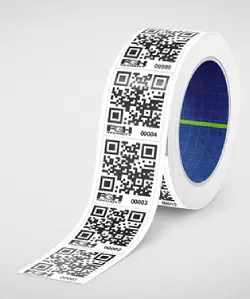
Traditional printing makes ten thousand identical labels. Variable data printing (VDP) makes ten thousand unique ones - each with its own serial number, QR code, barcode or text - at full production speed. That one change unlocks use cases that flat labels simply cannot do.
Here are the applications we see delivering real business results, drawn from projects across pharma, FMCG, cement and cosmetics. (Foundations in our VDP explainer; production details on the VDP labels page.)
1. Anti-Counterfeit Serialization
Every unit carries a unique, non-sequential code; customers or field staff verify it once against a server. Copied codes flag themselves the second time they are scanned. We built exactly this for a nutraceutical brand - unique QR per bottle with scan-to-verify - in our anti-counterfeit case study.
2. Batch, Lot & Expiry Coding - Without Inkjet Add-Ons
Instead of overprinting batch data on generic labels at the filling line (a common failure point), VDP prints batch, MFG/EXP and MRP data into the label itself - crisp, verified and impossible to misalign. See the cosmetic-industry implementation in our Eyetex case study.
3. Unit-Level Traceability
Serialized GS1 DataMatrix codes let you trace any single unit through warehouse, distributor and retailer - the backbone of pharma regulations worldwide and increasingly expected in food exports. Symbol standards covered in our GS1 guide.
4. Dealer & Consumer Loyalty Programmes
Unique scratch-and-scan QR coupons turn every pack into a promotion entry. A cement brand ran dealer loyalty exactly this way - unique QR coupons on every bag - detailed in the Ramco Cement case study. Redemption data doubles as a live distribution map.
5. Warranty Registration & Grey-Market Control
Serialized warranty labels tie each product to its sales channel and region. Scans from the wrong geography expose grey-market diversion; duplicate registrations expose fakes.
6. Personalisation & Limited Editions
Names, numbers (“Bottle 0417 of 5000”), regional language variants, city editions - VDP prints them in one run with zero changeover. Digital presses make micro-batches economical, as covered in digital vs flexo.
7. Logistics: SSCC Pallet & Carton Labels
Pre-printed serialized SSCC labels remove printing from the dispatch floor - no printer jams at 6 pm dispatch, no duplicated codes across shifts.
What VDP Needs From You
- Data or rules: a spreadsheet of codes, or a generation rule (we can generate securely).
- A verification decision: plain unique codes, or server-verified scan-to-check.
- Symbol choice: QR for consumers, DataMatrix for regulated marking, GS1-128 for logistics.
- Quality plan: per-code inspection so no unreadable or duplicated code ships.
Have a serialization or loyalty idea? Sai Impression prints VDP labels with per-code verification and can advise on the scan-to-verify backend. Talk through your use case →
FAQ
What is variable data printing on labels?
Printing where elements change on every label - serial numbers, QR codes, barcodes, names - within a single production run, at normal print speeds and quality.
How do unique QR codes stop counterfeiting?
Each genuine unit has a one-time code checked against a server. A counterfeiter can copy one code onto many fakes, but repeated scans of the same code from different places immediately expose the fraud.
Is VDP expensive for small quantities?
No - VDP runs on digital presses where uniqueness costs nothing extra per label. Even runs of a few thousand labels can carry unique codes economically.
Can variable data include both a QR code and human-readable text?
Yes - a typical serialized label carries the QR/DataMatrix, a human-readable code, and batch/expiry text, all driven from the same data row.